My New Book:
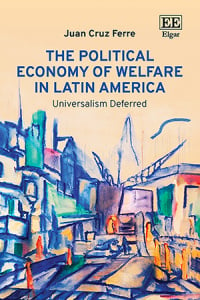
Political Economy of Welfare in 21st Century Latin America: Universalism, Deferred
This innovative book analyses the hurdles preventing Latin American governments from implementing universalist welfare regimes. Juan Cruz Ferre presents a unique quantitative analysis of the inequalities in welfare policy across this region including a three-dimensional diachronic assessment spanning inclusion, generosity, and equity, and a comparative historical analysis of pension and health reforms in Argentina, Chile, and Uruguay.
Available in February 2026
Contact me if you would like to host a book talk at your institution
Critical Acclaim:
This book offers a powerful class-analytic explanation of the progress and limitations of social policy reforms in Latin America in the 21st century. The author builds on and goes beyond previous works by providing an innovative theoretical framework to elucidate differential progress toward universalism, supported by compelling mixed methods empirical analysis. A must-read contribution!
Evelyne Huber, The University of North Carolina at Chapel Hill, USA
Juan Cruz Ferre has written a smart, sophisticated, and well researched book on the recent development of welfare policies in Latin America. He shows that despite progress on various fronts, especially in Uruguay, the region, as a whole, has failed to make progress toward universalist welfare regimes. On the contrary, a two-tiered structure has emerged which provides some citizens with less generous benefits than others – “second-class benefits for second-class citizens.” Ferre develops a persuasive Marxist explanation for this structure and other important developments in the region. This book should interest a wide range of scholars and students interested in Latin American social policies and politics in the 21st century.
Jeff Goodwin, New York University, USA
Juan Cruz Ferre’s book is a must-read publication on the analysis of welfare policy, state theory, and political economy in Latin America. It is likely to become a major reference in the study of social policy on that continent. It explains very well what is happening and the rise of the ultra-right in Latin America, and is relevant for other continents as well.
Vicente Navarro, Johns Hopkins University, USA and Founder and Honorary President of the International Association of Health Policy